Connect with:
Friday, May 22, 2026
Home2013January

Back in the late 1970s I worked in an abortion clinic that was fire-bombed by an anti-choice zealot. I wasn’t scheduled to  work that day. I arrived at the scene immediately after a co-worker telephoned me with the news.

Clinic staff stood together on the sidewalk watching the firefighters put out the blaze numb but determined we’d fight back.  No one was killed. Staff acted swiftly to get everyone out of the building. Most of the injuries suffered were invisible.

We quickly moved clinic operations to a location about 30 miles away. This was inconvenient and disruptive to the staff and people we served. There was limited complaining and a lot of collective action to make this work. Women counted on us.

Since then there has been an organized campaign by anti-choice extremists resulting in physicians and clinic workers being murdered; more abortion clinics bombed, burned down, invaded, and blockaded; and patients persistently being harassed and intimidated.

Ever wonder how the people who work in abortion clinics in our country are dealing with the violence and threat of violence in their lives on a day-to-day basis?


oil-field-workersWhere is corporate responsibility these days? I know it’s in the toilet, but I’m stunned by yet another example that is drastically affecting one state–North Dakota, where the prospects of hydrofracking and other oil exploration and production have dramatically increased the number of uninsured workers in the state.

Today’s New York Times includes an article about the impact of this oil boom in North Dakota on its health care system. Transient oil workers do dangerous work that too often results in an emergency room visit. Indeed, journalist John Eligon reports that ER visits increased by 400% last year alone at McKenzie County Hospital.

Emergency rooms cannot turn people away, so hospitals have to absorb the cost of uninsured care with the hope that it will be relieved by public funds designated for uncompensated care. Eligon cites McKenzie County Hospital’s debt load as an example of the impact of uninsured care on the state’s health care system. That hospital’s debt has increased 2000% over the past four years.

Linda KamatehThis is a guest post by Linda Kamateh who is a recent graduate of Syracuse University’s Newhouse Executive Master’s in Communications Management Program and a Senior Media Associate at NewYork-Presbyterian Hospital.

I just completed my graduate studies at Syracuse University’s Newhouse Executive Master’s in Communications Management ProgramI’ve spent the last year reading lengthy research studies and interviewing health care public relations professionals for my capstone on this topic. From this extensive research, I’ve compiled a list of the Seven Must Haves  to launch a social media health campaign.

Engagement with your audience is key and I discovered that while most of the communicators I spoke with use social media to post materials they are unclear or unable to use these mediums to engage with their audiences. The unique benefit of using social media outlets such as Twitter and Facebook is audience engagement.

Below are seven concepts that health care communicators should consider when developing social media campaigns or integrating social media into an existing mass media outreach effort to maximize engagement.

It’s been 40 years since the Supreme Court’s 7-2 decision affirmed the right of women to decide the issue of abortion for themselves. By invalidating restrictive state laws, the Court held that reproductive rights — at least during the first trimester of pregnancy — were a given under the Constitution. Wholesale bans and unreasonable restrictions on the procedure by states were in violation of the Fourteenth Amendment and a woman’s right to privacy.

The decision spawned a national debate about choice, government intrusion into personal lives, religion, ethics, and politics. It’s been a hot topic in every presidential race, many state and local contests, and has sharply divided this country into “pro-life” and “pro-choice” camps. The two movements are no closer to consensus in 2013 then they were in 1973.

roe-wade signsIf anything, the vitriol has become more intense and ugly. Medical professionals have been shot. Clinics bombed. Threats, violence, and vandalism common among some extremists. A few months ago, then-Rep.Todd Aiken’s ridiculous remarks about rape and pregnancy set off a firestorm in the state of Missouri, the nation, and unintentionally  helped several Democratic candidates in their respective races.

Many in the Republican party vow to pass legislation repealing Roe v Wade. The issue of [mostly] Republican, white males, who never have and of course never will become pregnant, telling women what they can or can’t do with their bodies might be humorous, if there wasn’t so much at stake. Unfortunately, some of them are doing a two-step around the law.

Texas recently defunded Planned Parenthood, making it extremely difficult, if not impossible for mostly poor, minority, and rural women to obtain any kind of health care – including well-women checkups and preventive screenings – let alone make a choice about pregnancy. Other states are following suit. The Guttmacher Institute developed a state-by-state breakdown of abortion laws and their major provisions. None seem as invasive as the new  Virginia law requiring a vaginal ultrasound for every woman undergoing an abortion prior to the procedure. It may be the ultimate invasion of privacy.

Anger and shame: Irish women protest following the death of Savita Halappanavar  Source: The Telegraph; Photo: AFP/Getty Images

Anger and shame: Irish women protest following the death of Savita Halappanavar Source: The Telegraph; Photo: AFP/Getty Images

I’m tempted to say that Savita Halappanavar died at University Hospital Galway in Ireland from a 17-week, wanted pregnancy that went awry. But it’s more accurate to say that she died in a Catholic country from a policy that deemed the heartbeat of a dying fetus to be more important than the life of its mother. Some may argue that Halappanavar would not have died had she been in a U.S. hospital, but after the wrangling over reproductive rights in the last year’s national elections I think she very well could have.
Halappanavar was 31 years old when she was admitted to University Hospital Galway for back pain. According to the Irish Times, she presented fully dilated and leaking amniotic fluid. When she was told that a miscarriage was in process, she requested that the pregnancy be terminated. But the fetus still had a heartbeat, her doctors said, which meant in that Catholic hospital and country that terminating the pregnancy was not permissible. It didn’t matter that she was not Catholic. Three days later, the fetus died and Savita Halappanavar was admitted to the intensive care unit, where she died of septicemia.

Abortion is illegal in Ireland, except to save the life of the mother. But, as noted in a 2010 report by Human Rights Watch, that country rarely supports this exception. Marianne Møllmann of Amnesty International maintains that health professionals in Ireland want clarity on when they can intervene in cases like Halappanavar’s without fear of criminal prosecution. Indeed, in the case of Halappanavar, the hospital and its clinicians essentially invoked a “conscience clause” that provides health care providers to opt out of intervening in ways that they find morally objectionable. Dr. Jen Gunter, an OB-GYN physician, has suggested that the clinicians didn’t intervene because they did not want to be judged as violating the country’s abortion laws and criminally prosecuted. She argues that Halappanavar’s symptoms should have assured that she receive pain medication and a termination of the pregnancy immediately to prevent sepsis.

Could this happen in the United States, where abortion is legal?

Source: Rainbow Babies and Children's Hospital

Source: Rainbow Babies and Children’s Hospital

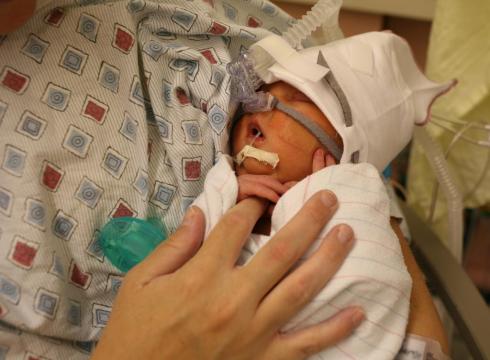
When you think of newborns who are in a neonatal intensive care unit, you assume that the baby is receiving the best of evidence-based care. There has been a great deal of research on medical interventions for these distressed newborns, but not as much nursing research on some of the important routine care issues. And this situation could worsen, depending upon the upcoming budget negotiations between President Obama and Congress. Consider the example of how to feed distressed, very ill neonates.

Gail McCain, PhD, RN, FAAN, Dean of the Hunter-Bellevue School of Nursing, has been studying the feeding of neonates for over two decades. Her work has been instrumental in our understanding of the cues that distressed neonates demonstrate to show they’re hungry. These cues are seldom the same as “term infants” (fully developed and delivered at a minimum of 40 weeks of gestation), so nurses, physicians, and even parents may not recognize that the neonate is hungry and ready to feed.

In the December 2012 issue of Nursing Research, widely considered the gold standard for nursing research journals, McCain and her colleagues report on a randomized clinical trial that focused on preterm infants with bronchopulmonary dysplasia, a condition in which the neonate’s underdeveloped lungs are injured from being on a ventilator and oxygen therapy for treatment of another respiratory condition, acute respiratory distress syndrome. These very sick infants are usually given tube feedings instead of nipple feedings. Nipple feedings can cause more respiratory distress, as the infant has to work to suck and may not have the energy reserves and oxygenation capacity to manage this. So the standard approach to helping these infants to transition from tube to nipple is to limit the nipple feedings to predetermined times and frequencies. In this new study, McCain and colleagues tried a different approach based upon their prior research.
The researchers compared the standard treatment with an experimental treatment that they call the “semidemand” method. Semidemand is based upon assessing the infant for non-term cues, such as simply being awake or sucking on fingers, instead of crying, and watching them carefully as they feed to make sure they don’t get into physiological trouble while feeding (e.g. “infant initiated and sustained sucking without cardiorespiratory distress”). This approach required continual assessment of the infant by the nurse to determine if the infant was becoming distressed from the feeding. As the researchers note in their paper, this approach “allowed for feedings to be led by the infant, rather than by the nurse.”