The Conundrum of Coordinating Care for Seniors
2 Comments
Care coordination for seniors is increasingly complex.



Care coordination for seniors is increasingly complex.
The 2013 Spring Forum of the Hunter-Bellevue
Healthstyles Thursday, March 14 11:00 PM to
CHMP's Envision Health: Film and New Media
Any typing I do between working the
CHMP Senior Fellow Charmaine Ruddock, MS directs Bronx Health REACH, a coalition of 50 community and faith-based organizations, funded by the Centers for Disease Control’s REACH 2010 Initiative to address racial and ethnic health disparities.
So now, the Bronx, in addition to having the designation as the poorest urban congressional district in the United States (approximately, 40% of residents live below the federal poverty level), has the additional, unfortunate, designation of being the hungriest neighborhood in the country.
Here is the irony; we also have one of the highest rates of obesity. For children – 1 out of 3 in the borough’s Head Start program is obese, and nearly 4 in 10 in public elementary schools are overweight or obese. For adults – 1 in 4 adults is obese, and 2 in 3 are overweight or obese.
The other irony is that the Hunts Point Terminal Produce Market, which is the second largest wholesale market in the world, supplying 60 percent of the city’s fresh produce, is located in the Bronx. But little of this gets to the hungriest Bronx residents, especially those in the South Bronx.
This seeming paradox of being the hungriest as well as the most overweight and obese actually reflects two sides of the same problem. Poor people with very limited resources also have access to the worst nutritional quality of food. What they can afford limits their food choices to those that are calorie dense but nutritionally poor. However, this represents a potential market for the cheap food industry, thus it should come as no surprise that there has been a large influx of fast food restaurants in the Bronx. And, if you read The Extraordinary Science of Addictive Junk Food in the New York Times Magazine you were made even further aware of the enormous odds that the poor and hungry face in trying to feed themselves and their families.
Tucked inside the pediatric clinic at Nassau University Medical Center (NUMC) in East Meadow, NY, is the help desk of Health Leads, a new program staffed by enthusiastic and committed students from Hofstra University.
These young advocates fill “prescriptions” for food, utilities, transportation, and other services for local families in need.
The program addresses non-medical needs of families that may affect their health and wellness, such as living environments, access to nutritious food, or child care. Clinicians learn about these needs through questionnaires that patients fill out at each visit. They then “prescribe” items like food, or electricity to run home health equipment just as they would prescribe an inhaler for asthma or antibiotic for an infection.
This is a first-of -its-kind program in Nassau County and could serve as a care model for other large suburban locales.
With support from a professional case manager, trained students connect families with appropriate resources and help them with applications, navigate red tape, and ensure needs are actually met. The students essentially act as case workers, helping families determine what services they are eligible for and how to traverse the often-confusing process of applying for aid or special programs.
May May Leung, PhD, RD is an
Jim Stubenrauch is a senior fellow at
Senior Fellow Nancy Cabelus, DNP, MSN, RN, is an international forensic nurse consultant currently working with Physicians for Human Rights on a program addressing sexual violence in conflict zones in central and east Africa.
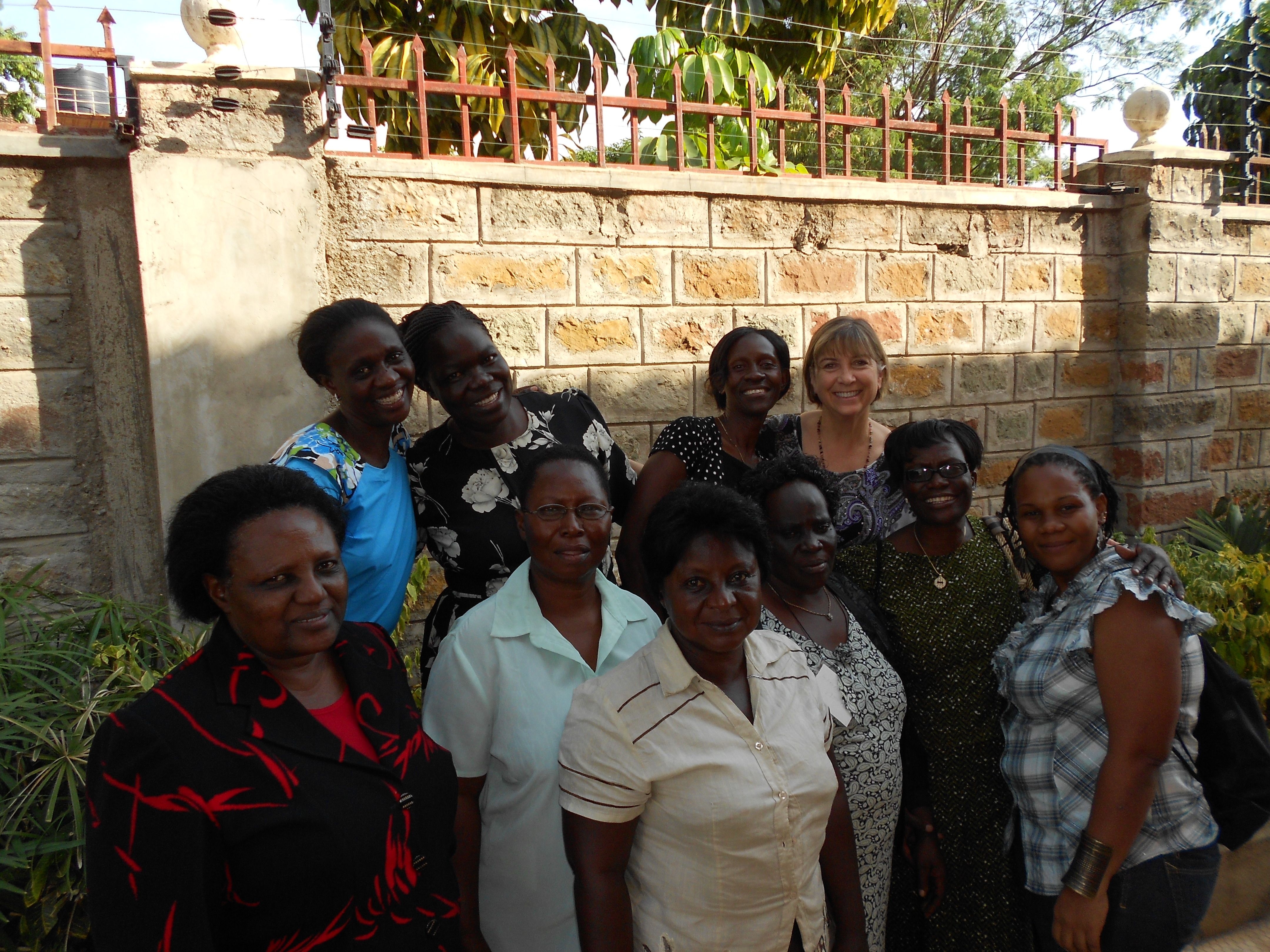
Nancy Cabelus with nurse colleagues in Kisumu, Kenya
In recent weeks I returned to Kenya to continue my work with Physicians for Human Rights, Program on Sexual Violence in Conflict Zones. In Kisumu, Kenya our team held a training workshop for 30 professionals on the cross-sectoral response to addressing the needs of survivors following sexual violence. Participants not only told us how greatly they appreciated the training but how important it was for them to meet and collaborate with colleagues from within their own community. It was an unusual opportunity that nurses and doctors would be invited to sit in the same training session as police officers, lawyers and magistrates. However, all sectors must learn to work together to properly investigate cases of sexual violence. A critical outcome of the workshop was that the participants all committed to holding follow-up meetings to continue collaborating on this newly formed network with a nurse taking the lead as the group coordinator.
Following the workshop, I returned to Nairobi where I had the pleasure of meeting Yeon Yoo, a registered nurse and trauma counselor from Seoul, Korea who has been working extensively with HIV infected women through an NGO called Harvest Women Center. Ms. Yoo is the daughter of CHMP Visiting Scholar, Nahmee Choi. Months ago, I virtually introduced Yoo and Choi to my Kenyan friend and colleague, Irene Mageto who resides in Nairobi. Mrs. Mageto is a registered nurse, lecturer, and PhD student.